




Platform
What Huml captures Huml Core Huml Connect In-treatment ROI Aftercare ROI
Platform overview Outcomes Evidence Security Why Huml Sign in Book a demo
Making behavioral health measurable

Recovery you can see.

Huml detects anomalies from wearables, voice, and location, giving clinicians clear next steps for proactive care, better documentation, and earlier intervention.

HIPAA compliantDirectly integrates into your EHRClinician-led, not AI-led
PERSONAL BASELINESLEEP 4H 12Mbelow typical rangeMONTUEWEDTHUFRISATSUN
Fig. 01 A week of signal against a personal baseline. The deviation is where the conversation starts.
Huml smartwatch showing a calm watch face
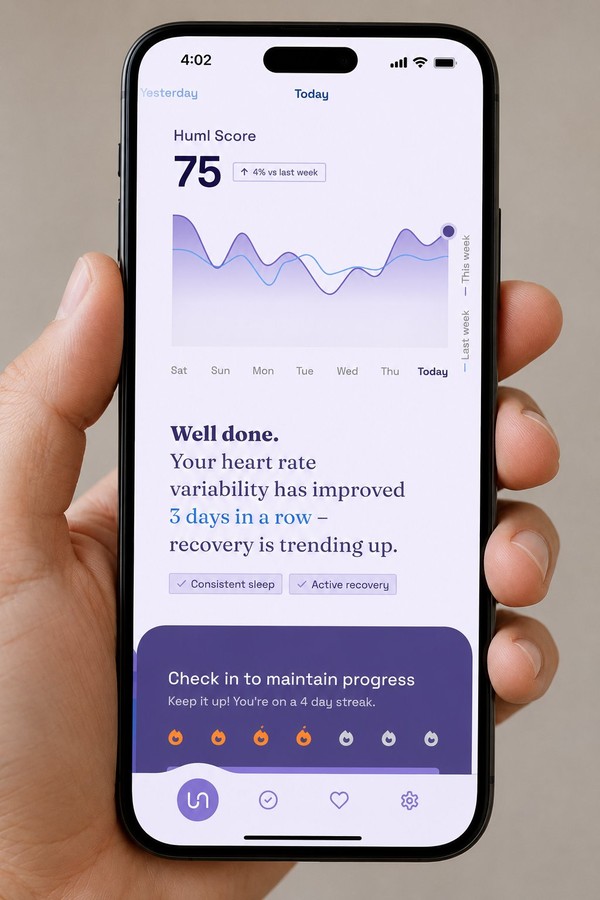
4:02●●● ▭
TodayYour check-ins
Heart rate variability steady 3 days in a row.
Check in to keep it goingTakes 30 seconds
Start with who you are

One platform. Three outcomes.

Pick the story that sounds like your week.

Clinical directors

See what self-report can't tell you

Hover to read →

A patient says they can't sleep and wants meds. You have their sleep data. Another patient's heart rate spikes every Sunday during calls home. Now you can see it, and ask about it. Assessments run themselves along the way.

See the clinical view →
Owners & executives

Protect the reimbursement that keeps your doors open

Hover to read →

Show referrers and payers a program that runs on data. Care responds to each patient's own baseline, because no two recoveries look alike. Monitoring continues past discharge, where most programs go dark. While others compete on amenities, you compete on evidence.

See the operator view →
UR & billing directors

Walk into authorization calls with objective evidence

Hover to read →

Give peer reviewers something they can verify instead of a narrative to debate. Recover the UR days lost to thin documentation.

See the UR view →
The real problem

The rest of medicine measures. Behavioral health asks.

01

Every other specialty has an objective measure

Cardiology reads an EKG. Endocrinology draws an A1c. Behavioral health hands the patient a questionnaire and asks them to remember their week.

02

One hour seen. 167 unseen.

A clinician gets one hour a week. The other 167 hours never reach the chart, and that's where the patient actually lives.

03

Payers approve what they can verify

A reviewer can't verify a narrative note. Payers are asking behavioral health for what every other specialty already provides: an objective basis to say yes.

Where Huml fits

We don't add to the pile. We attach to the pain you already have.

Huml isn't another assessment to run. Passive biometric and voice signal becomes a text alert when something needs attention, and one record three audiences can read: the clinician acts on it, billing defends with it, the payer understands it.

That's the move from want-to-have to need-to-have.

One platform, many signals

See recovery from every angle.

Biometrics, voice, location, and validated assessments feed one recovery picture, one investigation, and one record built for payer review.

What Huml captures

Passive biometrics

Heart rate, HRV, sleep, SpO2 and skin temperature from the wrist, around the clock.

Voice biomarkers

Vocal patterns linked to anxiety and depression, from a short daily prompt.

Location & GPS

Safety inside the facility, and GPS once they're beyond the four walls. One more signal that follows the patient instead of stopping at discharge.

Clinical assessments

12 validated instruments today, including the PHQ-9 and GAD-7. We can add any you use.

What Huml does with it

Monitoring & investigation

Huml flags anomalies and opens a guided clinician workflow.

Compliance & documentation

Records built for payer review and the 42 CFR Part 2 standard.

EHR & family

Write-back to your EHR, and family kept in the loop with the patient's consent.

One demo. Every seat at the table.

Clinical sees the signal. Billing sees the record. Leadership sees the math. Thirty minutes, on a real anonymized case.

How it works

Anomaly in. Signed record out.

Nothing for the patient to manage. When something needs attention, it reaches the clinician as a text, and the record lands in your EHR. Huml runs the loop in four moves.

Clinician-led, not AI-led. Huml surfaces the data. The clinician interprets it and signs. We never replace clinical judgment.
One platform for behavioral health.
Huml wearableWEARABLE
VOICE
LOCATION
01 · Capture

Wearable biometrics, voice check-ins, location, and assessments. Captured passively, all week.

02 · Analyze

Every signal is compared to that patient's own baseline, not a population average.

03 · Cluster

Signals are grouped across sources, so one rough night reads as context, not a string of separate alerts.

04 · Report

The clinician investigates, signs, and the record writes back to your EHR.

Fig. 02 The Huml workflow. The clinician decides at every step.

Built for the people in your care

Not tuned for the average wrist.

Patients in detox, residential, and PHP run baselines no consumer device understands. Withdrawal, medication, and broken sleep reshape what normal looks like.

An everyday tracker would tell them to take a walk. Huml learns each patient's own baseline and tells your team what changed and what to look into.

  • Personalized baselines per patient, not population averages
  • Tuned to cut false alarms, not chase every blip
  • Voice analysis for stress and mood a session can miss
Their baseline vs a one-size threshold
generic threshold, misses it personalized baseline band caught by baseline

See the workflow live.

From anomaly to signed record, on a real anonymized case.

Outcomes for everyone

Objective data is better for everyone at the table.

Recovery has run on subjective check-ins for decades. Huml adds objective signal, so patients, clinicians, and payers work from the same record. Nobody's the obstacle when everyone trusts the data.

For patients

Care that responds in real time

Clinicians see risk as it emerges, not weeks later. The right intervention lands when it counts. In aftercare, family and safety stay in the picture.

For facilities

Clinicians treat on evidence

Staff act on a clear signal instead of hunting for one. Documentation comes out of the workflow, not on top of it, and the facility can show its work to any reviewer.

For payers

Authorization backed by data

Reviewers approve care they can verify. Objective signal replaces subjective notes, giving reviewers an objective basis for the level of care.

One record. Two stories. Clinical proof of work for your team, objective documentation for the payer.

When a payer can see anomaly, response, and recovery on one timeline, the conversation changes. Less back-and-forth, more shared confidence in the care.

The economics

The right length of care, then a softer landing.

Across behavioral health, the money and the outcomes move together. Objective documentation helps patients get the length of treatment the clinical picture supports. Monitoring after discharge helps them stay connected to care when the risk is highest.

In treatment

The appropriate length of stay

When the record shows what care is doing, the patient is more likely to get the days the clinical picture supports, not the days a thin chart can defend. Better documentation, fewer premature discharges.

After treatment

Staying better, longer

Recovery is hardest after the doors close. Continued monitoring and timely outreach help keep patients connected to care, which is how programs reduce the costly returns: the ER visit, the readmission, the relapse.

In behavioral health the cost is measured in dollars and in lives. Care that fits the patient and follows them home protects both.

Run the math on your program.

Bring your census and your rates. We will pressure-test the model together.

Research foundation

The science isn't new. We made it measurable.

The Huml model sits on four pillars from the addiction and trauma literature. We're explicit about what's settled science and what's still ours to prove.

The body reflects the mind

Across behavioral health, what the body shows tracks with what the mind is going through.

HRV reflects autonomic state

Heart rate variability is an established window into stress and regulation.

Trauma lives in the body

Unresolved trauma drives dysregulation that shows up in physiology.

Connection changes outcomes

Randomized trials link lived-experience peer support to lower anxiety and better recovery.

Straight on the claims. The pillars rest on decades of published research. Huml's own clinical outcomes are being validated through active pilots. We separate proven science from results in progress, and we'll show you both.
The evidence base

The science was here first. We brought it together.

Continuous monitoring in behavioral health did not start with us. Researchers and clinicians spent two decades proving that the body carries signal: heart rate variability tracks mood and craving, sleep tracks recovery, wearables can read both. Their work is peer-reviewed and published, across the conditions we serve.

Our job is not to reinvent that science. It is to bring it together into one platform a treatment program can use, and to prove it in the real world, inside live care. We hold ourselves to the same standard the literature set: signals are wellness-grade, and a clinician reads them.

How it works
Wearables and continuous monitoring6 studies

The method, before the diagnosis. This is the foundational work showing consumer-grade wearables can passively and continuously capture clinically meaningful signal in daily life.

Peer support5 studies

A trusted human is one of the most studied non-clinical interventions in mental health, with randomized evidence across conditions and populations.

The evidence, by condition
Substance use disorder10 studies

The most developed condition-specific evidence in the field. Biometric signal can flag craving, distinguish use states, and track the autonomic recovery that unfolds over weeks in early sobriety.

On-body sensing of cocaine craving, euphoria, and drug-seeking
Gullapalli et al., 2019 · ACM IMWUT
Wearable cardiac and respiratory signal distinguished craving, euphoria, and drug-seeking states.
Wearable sensor-based detection of stress and craving during treatment
Carreiro et al., 2020 · Drug and Alcohol Dependence
Wrist sensors differentiated stress and craving events in outpatient treatment, with about 75 percent accuracy.
Real-time mobile detection of drug craving
Carreiro et al., 2020 · ACM IMWUT
Combined wearable and self-report data to surface craving in real time.
In natura HRV predicts subsequent alcohol use in early recovery
Eddie et al., 2023 · Addiction Biology
Lower HRV in everyday life preceded more alcohol use in the days that followed.
Identifying biomarkers of drug use recurrence using wearables and phone apps
Mahoney et al., 2023 · Drug and Alcohol Dependence
Wearable and phone data surfaced candidate digital biomarkers of return to use.
Patients with AUD show dampened HRV during sleep versus social drinkers
Wemm et al., 2023 · Alcohol and Alcoholism
Sleep-window HRV captured the autonomic recovery signal that distinguishes AUD from social drinking.
Heart rate variability in adults with substance use disorder: a review
Moon et al., 2023 · J. American Psychiatric Nurses Assoc.
Positions reduced HRV as a transdiagnostic indicator of autonomic dysregulation in addiction.
Wearable biosensors to detect physiologic change during opioid use
Carreiro et al., 2016 · J. Medical Toxicology
An early proof of concept that wrist-worn biosensors detect the physiologic change that follows opioid use.
Sleep disturbance in substance use disorders
Roehrs & Roth, 2015 · Psychiatric Clinics of N. America
Reviews how disrupted sleep both results from and drives relapse, making wearable sleep data recovery-state data.
Peer recovery support for individuals with SUD: assessing the evidence
Reif et al., 2014 · Psychiatric Services
A systematic review finding moderate evidence that peer support reduces relapse and improves retention.
Maternal mental health5 studies

Perinatal depression and anxiety are underscreened and often missed. Consumer wearables can surface the physiological changes that in-person visits don't catch.

Eating disorders5 studies

Eating disorders carry the highest mortality in psychiatry, much of it cardiac. The autonomic nervous system is measurably altered, and wearable signal is being studied to anticipate disordered-eating episodes.

Depression4 studies

Passive signal from wearables tracks mood trajectories, opening a window between appointments when symptoms shift.

Anxiety5 studies

Anxiety shows up in autonomic signal. Wearable HRV separates people with anxiety disorders from controls and tracks anxiety states as they rise.

Post-traumatic stress disorder4 studies

Trauma shows up in the autonomic nervous system. Wearable signal is being used to flag hyperarousal in the moment and to identify who is struggling after a traumatic exposure.

35 selected studies, several spanning more than one condition. Each links to its source. For the full annotated bibliography, contact the team.

Proof

Earned inside real programs.

Not a pilot deck. Three years of continuous monitoring inside live treatment centers, with the partners and researchers behind it.

3,000+
Patients in our retrospective dataset
Huml internal data, 2026
120
Datapoints per patient, every day
Huml internal data, 2026
3 yrs
Inside live treatment centers
Huml internal data, 2026
Pathways Recovery
Lumina
Alter Behavioral Health
Care Predictor
Kipu
Samsung
McLean Hospital
Lightning Step
Sunwave
Why we built Huml

Built by people who lived it.

This is personal. Our team brings together treatment center operators, AI engineers, and connected-device builders. Several of us are in recovery.

Meet the team and read our story

Ask us the hard questions.

We will show you what is proven, what is in progress, and the difference.

Security & compliance

The strictest data rules in healthcare. We started there.

Substance use records fall under 42 CFR Part 2, a tighter standard than HIPAA. Consent gates every disclosure before anything is shared.

42 CFR Part 2

Cross-facility sharing runs on explicit, tracked consent with redisclosure limits under the 2024 Final Rule.

HIPAA + BAAs

Encryption in transit and at rest, full audit logging, and a signed agreement with every subprocessor.

Your data stays yours

We never sell your data. We only share it with your care team and the subprocessors under a signed BAA. The device fleet is locked down and centrally managed.

Bring your compliance team.

We will walk consent, audit logging, and data flows end to end.

Why Huml

Built by people who lived it.

This is personal. Our team brings together treatment center operators, AI engineers, and connected-device builders. Several of us are in recovery.

We watched good programs deliver real care and struggle to show it. We watched clinicians spend nights on documentation instead of patients. And we knew from our own lives that recovery shows up in the body long before it shows up in a progress note.

So we built the platform we wished our own programs had. Objective signal, a clinician-led workflow, and a record everyone at the table can trust.

Our operating rule. Huml surfaces data. Clinicians make every clinical decision. We never replace clinical judgment, and we never sell your data.
The team

The people behind Huml.

Rachel
RachelCEO
Read bio

Rachel leads Huml. Before founding the company she was a general partner at Hivers & Strivers Capital, backing more than 20 early-stage companies and raising over $80M. She started Huml after watching someone she loves cycle through treatment with no continuity between sessions. A Wesleyan graduate and former soccer captain, she runs the company with one focus: reach the people the system loses.

Robby
RobbyFounder
Read bio

Robby has spent his career inside addiction treatment. He got sober at 29, then helped build Kipu, the EHR that now powers thousands of treatment centers. He built and sold a residential treatment center, and founded Hygea Healthcare, three facilities he still runs. He started Huml to fix what he saw from the inside: an industry running on a model from 1935 that measures almost nothing.

Sapoon
SapoonEngineering
Patrick
PatrickEngineering
Stefan
StefanEngineering
Kent
KentEngineering

Come see what we built.

Thirty minutes with the people who lived the problem.

← Platform
What Huml captures

Four streams of signal. One picture of the week.

Huml captures four kinds of signal, passively and continuously, then compares each one to the patient's own baseline. Wearable biometrics, voice, location, and validated assessments.

01 · Biometrics

What the body shows.

A facility-managed wearable measures the physical signals of recovery around the clock. Each metric is tracked against the patient's own range, not a population average.

Heart rate

Resting and active, all day.

Heart rate variability

A window into stress and recovery load.

Sleep

Duration and disruption, night over night.

O2
Blood oxygen

SpO2 trends overnight and across the day.

Skin temperature

Subtle shifts that track with the body's rhythm.

02 · Voice

What the voice carries.

A short spoken check-in, a minute of talking, is analyzed for acoustic markers in speech that research links to anxiety and depression. The patient just answers a prompt. Huml does the rest.

Voice is easier than typing for someone in early recovery, and it gives the care team another independent signal alongside the body.

Built for payer review. Each voice check-in is a documented, time-stamped clinical touchpoint. That documentation supports reimbursement and stands up when a payer asks what care was delivered.
03 · Location

Where the patient is, when it matters.

Inside the facility

In residential care, location shows presence and movement inside the building, who is where, safely, without a phone.

Beyond the four walls

In aftercare on the patient's own phone, GPS adds a safety signal through the high-risk window after discharge. Shared with consent.

04 · Assessments

What the patient reports.

Huml runs validated clinical instruments as simple prompts, scored automatically and tracked over time. Twelve instruments today, configurable to the ones your program already uses.

PHQ-9Depression severity
PHQ-15Somatic symptoms
GAD-7Anxiety severity
URICAReadiness to change
BAMBrief Addiction Monitor
BAM-IOPAddiction Monitor, IOP
+ custom instruments

Assign standard instruments, or build a custom one for a client. If it is validated, we can add it.

Where the signal goes

One stream of signal. Two destinations.

Everything Huml captures flows to the people responsible for the patient's care, in treatment and after it.

Captured signal
BiometricsVoiceLocationAssessments
In treatment · Huml Core

To the clinician, then the chart

Huml flags anomalies against the patient's own baseline and texts the clinician. The clinician reviews, signs, and the record writes back to your EHR, where the rest of the chart lives.

SignalClinicianEHR
After treatment · Huml Connect

To the circle of support

The care team stays informed through step-down and aftercare. And with the patient's consent, the people who hold the line can stay in the loop too: a loved one, a sponsor, a peer coach, an alumni coordinator, or the clinician in PHP and IOP. Governed by 42 CFR Part 2. The patient stays in control.

SignalCare teamFamily · Sponsor · Coach · Alumni coordinator

Fig. 03 Consent decides who sees what. The patient holds the switch.

← Platform
Huml Core · Residential & inpatient

Inside the four walls, around the clock.

Your clinicians see each patient a few hours a day. Core watches the signal the other twenty, on a facility-managed smartwatch, and turns it into records your whole building can run on.

Clinician-led, not AI-led. Core surfaces the data. The clinician interprets it and signs. We never replace clinical judgment.
What you get

Six reasons the answer is yes.

The body talks all week

Groups are an hour. Core tracks heart rate, HRV, sleep, SpO2, and skin temperature around the clock, against each patient's own baseline. A patient says they can't sleep and wants meds. You have their sleep data.

Know who is where

Location inside the facility, visible to staff. Night shifts run thin; Core gives the overnight team another set of eyes. When minutes matter, no one is searching room to room.

The voice carries signal

A one-minute voice check-in carries acoustic markers research links to anxiety and depression. One more objective input for the med conversation and the treatment plan review, without adding a session.

Built for the UR call

Every anomaly, investigation, and signed note is time-stamped, objective, and built for payer review. When the reviewer asks why day 18 was needed, the chart answers, instead of your UR director improvising.

Safety and compliance, settled

HIPAA compliant, BAA on request. Consent governs sharing, with 42 CFR Part 2 where it applies. Signals are wellness-grade and inform clinical judgment, never replace it. Your data stays yours. We never sell it.

No dashboard to log into

Huml sends a text when an anomaly needs a look. The documentation goes straight into your EHR, so the chart stays complete and your team works where they already work. The dashboard is there if you want to dig into the history, not a place you have to live.

Another set of eyes on every overnight shift.
Objective evidence in every peer review.
Zero new workflow for your clinicians.
Patients wear it. That is their whole job.
While others compete on amenities, you compete on evidence.
The practical questions

What does it run on?

A facility-managed, locked-down smartwatch. Nothing for the patient to set up or maintain. Devices stay with the program.

What changes for my staff?

Not much. Anomalies come to your team as a text, and the documentation flows into your EHR. No new system to learn, no dashboard to keep open. The Huml dashboard is there if you want to dig deeper.

Who is it for?

Residential and inpatient programs across behavioral health that want objective signal between sessions and documentation that holds up.

What happens at step-down?

The signal moves to the patient's own phone. Huml Connect carries it through PHP, IOP, aftercare, and alumni.

Calculate your ROI

Put real numbers on what you're losing.

Documentation gaps cost authorized days. Set the sliders to your program and see what tighter, objective records protect.

Clients in your program50
Average active census across your levels of care.
Reimbursement per authorized day$450
Your blended daily rate. Adjust to your payer mix.
Added authorized days per client, monthly3
Days you recover when documentation holds up under review.
Protected reimbursement, per month
$67,500
150 authorized days recovered each month
$810,000per year
Pressure-test these numbers

Illustrative, based on the inputs you set. Not a guarantee of reimbursement or clinical outcomes. Source: Huml internal modeling, 2026.

See Core on a real case.

Thirty minutes. The overnight signal, the investigation, and the record a reviewer sees.

← Platform
Huml Connect

Beyond the four walls, where recovery gets hard.

Huml Connect is the aftercare product for PHP, IOP, and alumni. The patient moves to their own wearable and app. The signal carries through step-down and discharge, the highest-risk window, and keeps the right people close.

A calm app for the patient. Real signal for the team.

On their own phone, the patient sees a simple, supportive experience: check-ins, assessments, voice prompts, and gentle nudges. Behind it, Huml keeps measuring and keeps the right people in the loop.

  • + Runs on the patient's own phone
  • + Works on iOS and Android
  • + Works with the wearable they already own
  • + Location and GPS for aftercare safety
  • + Family access, with patient consent
  • + Governed by 42 CFR Part 2
Huml Connect app home screen
Hardware agnostic

Use the wearable they already own.

Connect does not lock you into one device. It works with the wearables your patients already wear, so there is no program hardware to buy or manage.

Bring your ownConnect to the watch or ring a patient already wears.
Need a device?$50 to $300Pick from our suggested list.
One platformThe same signal, whatever they wear, read against each patient's own baseline.
Peer recovery coaches

The person who has been there.

Aftercare is where peer recovery coaches do their best work, and where they usually fly blind between calls. Connect gives them something to work with. The same loop serves alumni coordinators, clinicians in PHP and IOP, family, and sponsors.

A reason to reach out

When a patient's signal shifts, the coach knows to check in, before a quiet week becomes a missed one.

Context for the call

The coach walks into the conversation knowing how the week actually went, not just what gets said out loud.

Shared with consent

What the coach can see is governed by the patient's consent and 42 CFR Part 2. The patient stays in control.

Part of the record

Coach touchpoints become part of the documented continuity of care the payer is looking for.

The model

A trusted person is the intervention. Huml is the timing layer.

Across behavioral health, the strongest support is a trusted human. Huml helps that human know when to reach out, never what to conclude.

Who that is depends on the program and the moment:Peer coachAlumni coordinatorClinician, in PHP & IOPFamily memberSponsor
Theperson1OPTS IN, CHOOSES THEIR PEOPLE2LIVES THE WEEK,SIGNAL READ QUIETLY3PATTERN SHIFTS, THEIR PERSONGETS A GENTLE NUDGE4A HUMANREACHES OUT

Fig. 04 The peer coach loop. Consent opens it, a person closes it.

1 · They opt in

The person chooses who is in their loop, a coach, a coordinator, a clinician, family, a sponsor, and exactly what each one can see. Per recipient, revocable.

2 · They live their week

The wearable reads rhythms quietly. No condition labels, no agency feed, nothing flagged behind their back.

3 · Their person gets a nudge

When patterns shift, that person sees a gentle, wellbeing-framed prompt: rough few nights, maybe check in.

4 · A human reaches out

Support, not assessment. The relationship does the work.

If crisis

Whoever reaches out follows a warm-handoff protocol, escalating to clinical and crisis care. Defined before launch, not improvised.

Calculate aftercare ROI

The savings show up after discharge.

In aftercare, value comes from what does not happen: the ER visit avoided, the readmission prevented. Set the sliders to your program.

Patients in aftercare120
Readmissions avoided per month4
Earlier intervention can prevent a return to a higher level of care.
Cost of one readmission$18,000
ER visits avoided per month10
Cost of one ER visit$2,600
Avoided cost, monthly$0
Avoided cost, annually$0
Placeholder assumptions for illustration, pending finance confirmation. Not a guarantee of savings.
Newsroom

Huml in the news.

Coverage and milestones from the team. For press inquiries, reach out.

Dec 2025

From captain's poise to builder's focus

Wesleyan University

Wesleyan profiles CEO Rachel Hobert, from soccer captain to founder, and how Huml turns wearable data and voice biomarkers into insight clinicians can trust.

Press
Oct 2025

Hygea Healthcare partners with Huml

Hygea Healthcare

Hygea Healthcare adopts Huml to bridge inpatient care and post-discharge recovery, giving clinicians insight into each client's wellbeing.

Partnership
2025

Named to the Inc. Female Founders 500

Founder and CEO Rachel Hobert was recognized on Inc.'s Female Founders 500, honoring the women building the most consequential companies in America.

Milestone

More soon. We post funding, partnership, and product news here as it happens.

Book a demo

Thirty minutes. One demo.

We'll walk the full workflow on a real anonymized record: the anomaly, the investigation, and the documentation a reviewer sees.

The signalLive biometrics and voice against a personal baseline
The workflowHow an alert becomes a signed record
The mathYour ROI, with your numbers
Before you book
Does Huml work with our EHR?

Huml writes records back to multiple EHRs. Bring yours to the demo and we will confirm fit on the call.

How long does it take to get running?

Devices arrive configured, and our team runs onboarding with yours. We will map a timeline to your program on the call.

How is it priced?

We will walk pricing for your program size on the call. No surprises, and no obligation.

Is patient data protected?

HIPAA compliant, with consent-governed sharing built to the 42 CFR Part 2 standard. We never sell your data.

Who decides what an alert means?

The clinician, every time. Huml surfaces signal. It never replaces clinical judgment.

Why Huml over other tools?

Huml brings three things into one place: wearable biometrics, client-reported assessments, and pattern recognition that surfaces signal for the clinician. It writes back to your EHR, so insights are easy to act on and share.

Does Huml replace our treatment methods?

No. Huml works alongside what you already do. It adds objective insight and accountability, it does not replace clinical care.

What does the wearable track?

Heart rate, heart rate variability, sleep, blood oxygen, skin temperature, and movement, around the clock against each client's own baseline.

What assessments can we use?

Standard instruments including PHQ-9, PHQ-15, GAD-7, URICA, BAM, and BAM-IOP, plus custom assessments. They run in the app, so there is less admin and a smoother audit.

How does the pattern recognition work?

It learns each client's normal range and flags when signal moves away from it, so the clinician sees a shift earlier. The clinician interprets and decides. It is decision support, not a diagnosis.

Can we use Huml after discharge?

Yes, and that is where it does some of its best work. Huml Connect carries monitoring and support through aftercare, when relapse risk is highest.